Why Your Air Conditioner Stopped Working During a Heat Wave
The hottest week of the summer is exactly when your air conditioner decides to quit. If your air conditioner stopped working during a heat wave, there’s a reason it happened then and not in April. Understanding that reason is the first step toward getting it fixed fast.
At Fresh Air Flow, we handle more emergency calls during South Jersey heat waves than any other time of year. Here’s what’s happening when your system fails under extreme heat.
TL;DR
Air conditioners are most likely to fail during heat waves because extreme heat pushes aging or undermaintained systems past their limits. The most common causes are a refrigerant problem, a failing capacitor, a dirty condenser coil, or a system that was already struggling before temperatures spiked.
Key Takeaways
- Heat waves expose weaknesses that already existed in your system
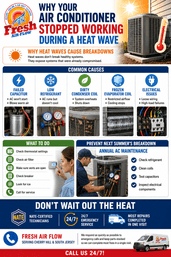
- The most common causes of heat wave failures include low refrigerant, failed capacitor, dirty condenser coil, frozen evaporator coil, and electrical issues
- An AC not keeping up in summer during a heat wave may not be a full breakdown
- Regular AC maintenance is the best way to prevent heat wave failures
Why Heat Waves Push AC Systems to the Breaking Point
When outdoor temps soar to triple digits for days at a time, your air conditioner has to run nonstop to keep up. That kind of sustained, heavy operation reveals every weak point in the system.
Heat waves don’t break healthy systems: they expose systems that were already compromised.
AC Not Keeping Up During Heat Wave? Here’s Why
Failed Capacitor
The capacitor gives the compressor and fan motors the electrical boost they need to start up and keep running. It’s one of the most common failure points we see during emergency AC repair calls.
Capacitors degrade over time and are especially vulnerable under the sustained high-voltage demand of a heat wave. When one fails, the compressor or fan motor won’t start. Your system either blows warm air or doesn’t come on at all.
Low Refrigerant
Refrigerant doesn’t get “used up” like fuel. If your system is low, it means there’s a leak. A system running low on refrigerant loses the ability to absorb heat, so the AC system stops cooling even though it appears to be running.
Dirty or Blocked Condenser Coil
The outdoor unit needs to dump the heat it pulls from your home into the outside air. When the condenser coil is caked with dirt, grass clippings, or debris, it can’t transfer heat. The system overheats, trips a safety switch, or shuts down.
Frozen Evaporator Coil
It sounds counterintuitive, but your AC can freeze during the hottest weather. When airflow is restricted, the evaporator coil gets too cold and ice forms on it. Once the coil is frozen, air can’t pass through it and cooling stops.
If you notice ice on your refrigerant lines or around the indoor unit, turn the system off immediately and call for service. Running a frozen system damages the compressor.
Electrical and Wiring Issues
Sustained high-load operation generates heat throughout the system’s electrical components. Loose connections, worn contactors, and degraded wiring that held together under normal conditions can fail when the system runs at full capacity for extended periods.
What to Do When Your AC Stops Working in a Heat Wave
- Check the basics. Before calling for HVAC repair, make sure the thermostat is set to “cool” and is below current room temperature, the air filter isn’t clogged, all vents are open, and the circuit breaker hasn’t tripped.
- Check the outdoor unit. If the indoor air handler is on but the outdoor unit is silent and not spinning, you likely have a capacitor, contactor, or electrical failure.
- Look for ice. If you see ice anywhere on the system, turn it off and switch the fan to “on” (not “auto”) to help it thaw. Then call for service.
- Call for service. A system that’s struggling today may be down tomorrow. The sooner a technician diagnoses the issue, the better chance you have of a same-day repair.
Fresh Air Flow provides AC repair in Cherry Hill and throughout South Jersey. We respond as quickly as possible to emergency calls and keep parts stocked so we can complete most fixes in a single visit.
How to Prevent This Next Summer
The most predictable thing about heat wave breakdowns is they almost always happen in systems that skipped annual maintenance. Regular AC maintenance in the spring catches failing capacitors, low refrigerant, dirty coils, and loose electrical connections before they become emergencies in July.

FAQs
Why does my AC break on the hottest days?
Heat waves often push aging or undermaintained systems past their limits. Components that were operating marginally under normal conditions fail under sustained maximum load. Healthy, well-maintained systems handle heat waves without issue.
What should I do when my AC stops working in summer?
Check your thermostat settings, air filter, and circuit breaker first. If those are fine, check whether the outdoor unit is running. If it isn’t, the problem is likely electrical or mechanical and requires an AC technician.
How quickly can Fresh Air Flow respond to an emergency AC repair call?
We respond to emergency calls as quickly as possible during business hours and maintain 24/7 office availability so you can always reach someone. Response times depend on how many technicians are available and the number of service calls we’ve received.
Can I prevent my AC from breaking down during a heat wave?
Yes. Scheduling annual spring maintenance is the most reliable way you can prevent your AC from breaking down. A professional tune-up catches the components most likely to fail under heat wave conditions.
Don’t Wait Out the Heat—Call Fresh Air Flow
If your air conditioner stopped working or is struggling to keep up, the problem won’t improve on its own in 95-degree weather. The longer you wait, the harder it is on the rest of the system.
Fresh Air Flow has been handling AC repair in South Jersey for years. Our NATE-certified technicians diagnose problems correctly the first time, back every repair with a two-year warranty, and follow up after the visit to make sure everything is working as it should. Call us 24/7!